
How Healthcare Business Owners Can Add NEMT and Grow Under a Proven Franchise Brand

If you already operate in healthcare, you understand the critical role that reliable transportation plays in patient outcomes. Whether you run a home healthcare agency, an assisted living community, a medical staffing firm, or a related healthcare business, you have likely seen firsthand what happens when patients miss appointments, arrive late, or cannot access the care they need.
Adding non-emergency medical transportation (NEMT) to your existing operation is a natural extension of the work you already do — and Safe Travels Transportation offers a franchise model designed to help qualified business owners enter or expand within this growing segment of healthcare.
Request Safe Travels Franchise Information today to explore how NEMT ownership may complement your current healthcare operation.
Why Healthcare Business Owners Are Well Positioned for NEMT
Running a healthcare-related business gives you a significant head start over someone entering NEMT with no industry background. You may already have established relationships with hospitals, clinics, rehabilitation centers, dialysis providers, senior communities, and case managers. Those relationships can be the foundation of a successful transportation operation.
Beyond your network, you understand patient care expectations, HIPAA considerations, scheduling demands, and the operational complexity of serving medically fragile individuals. That experience transfers directly to NEMT ownership — and operating under a franchise brand that has already built systems and training around these realities can help you launch with greater confidence.
What Non-Emergency Medical Transportation Actually Involves
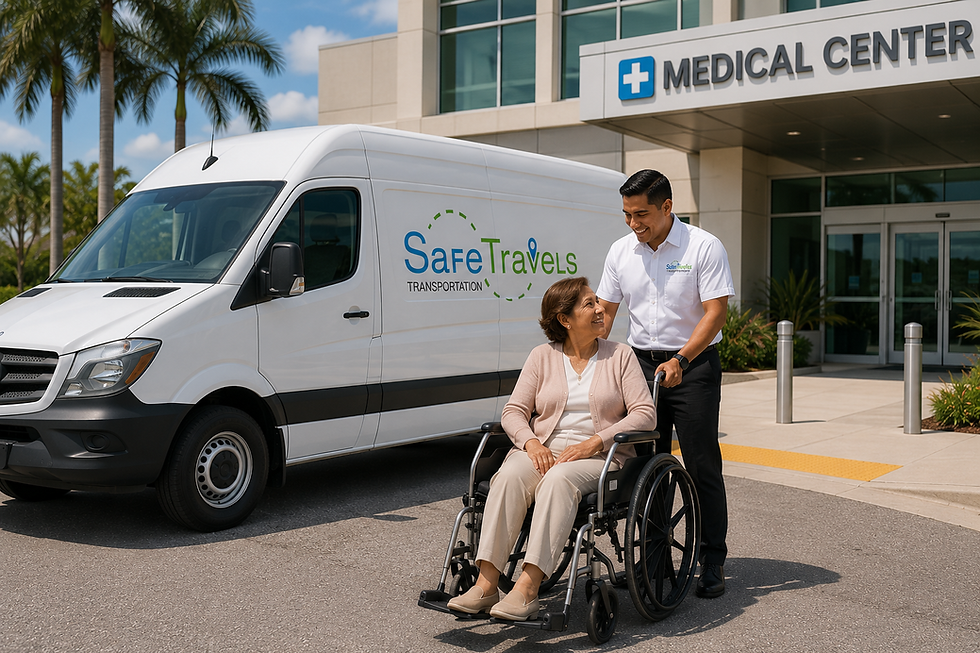
Non-emergency medical transportation provides scheduled, door-to-door rides for passengers who need to reach medical appointments, therapy sessions, dialysis centers, specialist offices, and other healthcare destinations — but do not require emergency ambulance services.
Safe Travels Transportation serves passengers who may require ambulatory assistance, wheelchair-accessible vehicles, stretcher transport, or bariatric accommodations. The population that benefits most includes seniors, individuals with disabilities, post-surgical patients, dialysis recipients, and others with limited mobility or access to personal transportation.
The Difference Between Emergency and Non-Emergency Transport
NEMT is not an ambulance service. Rides are scheduled in advance, often for recurring appointments, and drivers are trained to assist passengers safely rather than provide emergency medical intervention. This distinction is important as you consider how NEMT may fit alongside your existing healthcare services.
For your current clients or patients — whether in a home care setting, an assisted living environment, or a staffing context — reliable non-emergency transportation can mean the difference between completing a treatment plan and missing critical appointments.
How NEMT May Complement Your Existing Healthcare Business
Adding NEMT to a healthcare business is not simply about diversifying revenue. It is about extending the depth of service you provide to the same population you already serve. Consider how transportation access affects the following types of businesses.
Home healthcare agencies: Clients need transportation to follow-up appointments, specialist visits, and lab work. Providing or coordinating transport extends the continuity of care your agency already delivers.
Assisted living and senior-care communities: Residents depend on scheduled rides to medical appointments, therapies, and procedures. Reliable NEMT can improve resident satisfaction and reduce the burden on community staff.
Medical staffing agencies: Your nurses, aides, and other clinical professionals already serve patients in homes and facilities. Transportation access can affect patient compliance and outcomes for the same individuals your staff serves.
Rehabilitation and physical therapy providers: Consistent attendance is central to therapy outcomes. Transportation barriers are among the leading reasons patients disengage from treatment.
Durable medical equipment businesses: Your customers may already struggle with mobility. A trusted NEMT operation can create an additional service touchpoint within the same network.
It is important to note that legal and operational requirements for any shared staffing, vehicles, licenses, or regulated services vary by state and must be independently verified. Safe Travels franchisees operate their transportation business as its own entity, subject to state and local requirements.

What the Safe Travels Franchise Is Designed to Provide
One of the core reasons healthcare business owners explore the Safe Travels franchise model is that it is designed to help qualified owners launch with established systems, training, and brand support rather than building entirely from scratch.
Systems and Technology
NEMT operations depend on accurate scheduling, dispatching, route management, and billing. The franchise model is designed to connect franchisees with technology platforms built for medical transportation — so you are not selecting and configuring software from the ground up during your launch period.
Training and Operational Guidance
Even experienced healthcare operators benefit from transportation-specific training. Safe Travels is designed to provide franchisees with launch training and ongoing operational support covering driver standards, passenger assistance protocols, vehicle requirements, and administrative processes. This guidance is designed to help you meet the care expectations of medical referral partners and private-pay clients.
Marketing and Brand Recognition
Starting a new transportation business requires building trust among healthcare decision-makers — social workers, discharge planners, facility administrators, and referring physicians. Operating under an established brand can support that credibility-building process. Safe Travels franchisees benefit from a recognized brand identity, marketing materials, and a framework for approaching healthcare referral sources professionally.
Explore NEMT Franchise Ownership with Safe Travels Transportation — learn how the franchise model is structured and what support may be available to qualified franchise owners.
Building Healthcare Referral Relationships as a Franchise Owner
For healthcare business owners entering NEMT, referral relationships are often the most powerful element in building a transportation client base. Discharge planners, social workers, case managers, dialysis center coordinators, and assisted living staff are regularly asked to recommend transportation services.
If you already have relationships in these settings — either from your current business or from prior clinical or administrative work — those connections may carry significant value as you build a transportation referral network. The Safe Travels franchise model includes guidance designed to help franchisees develop and maintain these professional relationships.
Private-Pay Versus Broker-Based Transportation
NEMT franchisees may have the opportunity to serve clients through both private-pay arrangements and transportation broker networks. Private-pay clients — those who pay directly or through private insurance — can include assisted living residents, private home care clients, and patients without Medicaid coverage who still require transportation assistance.
Broker-based models involve contracting with transportation brokers who manage Medicaid-funded ride assignments. Each approach carries its own operational and financial characteristics. Prospective franchise owners should review all relevant terms and consult independent advisors as part of their due diligence.

Questions to Ask Before You Invest in an NEMT Franchise
Every prospective franchise owner should approach any investment decision thoughtfully. Before you move forward, consider asking the following:
What training and launch support will I receive, and how long does it last?
What technology platforms are included, and how does scheduling and dispatch work?
What are the state-level licensing, insurance, and vehicle requirements in my target market?
How does the franchise model support ongoing operations after launch?
What does the Franchise Disclosure Document say about fees, obligations, and franchisee rights?
All prospective franchisees should review the current Franchise Disclosure Document carefully and consult independent legal and financial advisors before making any investment decision. Results vary, and no specific income, profit, or volume outcome is guaranteed.
Is NEMT Franchise Ownership the Right Next Step for Your Business?
If you are already working within healthcare and see transportation access as a gap in the services available to the patients, clients, or residents you serve, NEMT franchise ownership may be worth exploring. The Safe Travels Transportation franchise model is designed for healthcare and transportation professionals who want to operate under an established brand with systems, training, and support in place.
Your existing experience, professional relationships, and understanding of the healthcare environment may position you for a more informed and connected launch than someone entering the industry without that background.
The aging population continues to grow, the demand for accessible medical transportation continues to increase, and communities across the country are looking for dependable, professional NEMT operators. If you are a healthcare business owner ready to consider what comes next, the franchise inquiry process is your starting point.
Discover the Safe Travels Franchise Opportunity — complete the franchise inquiry form to share your background, your target area, and your ownership goals. Our team will follow up to discuss next steps.
This article is intended for informational purposes only. All franchise investment decisions should be made after reviewing the current Franchise Disclosure Document and consulting independent legal and financial advisors. State and local licensing, vehicle, and insurance requirements vary and must be independently verified. No earnings, profits, or specific outcomes are guaranteed.


